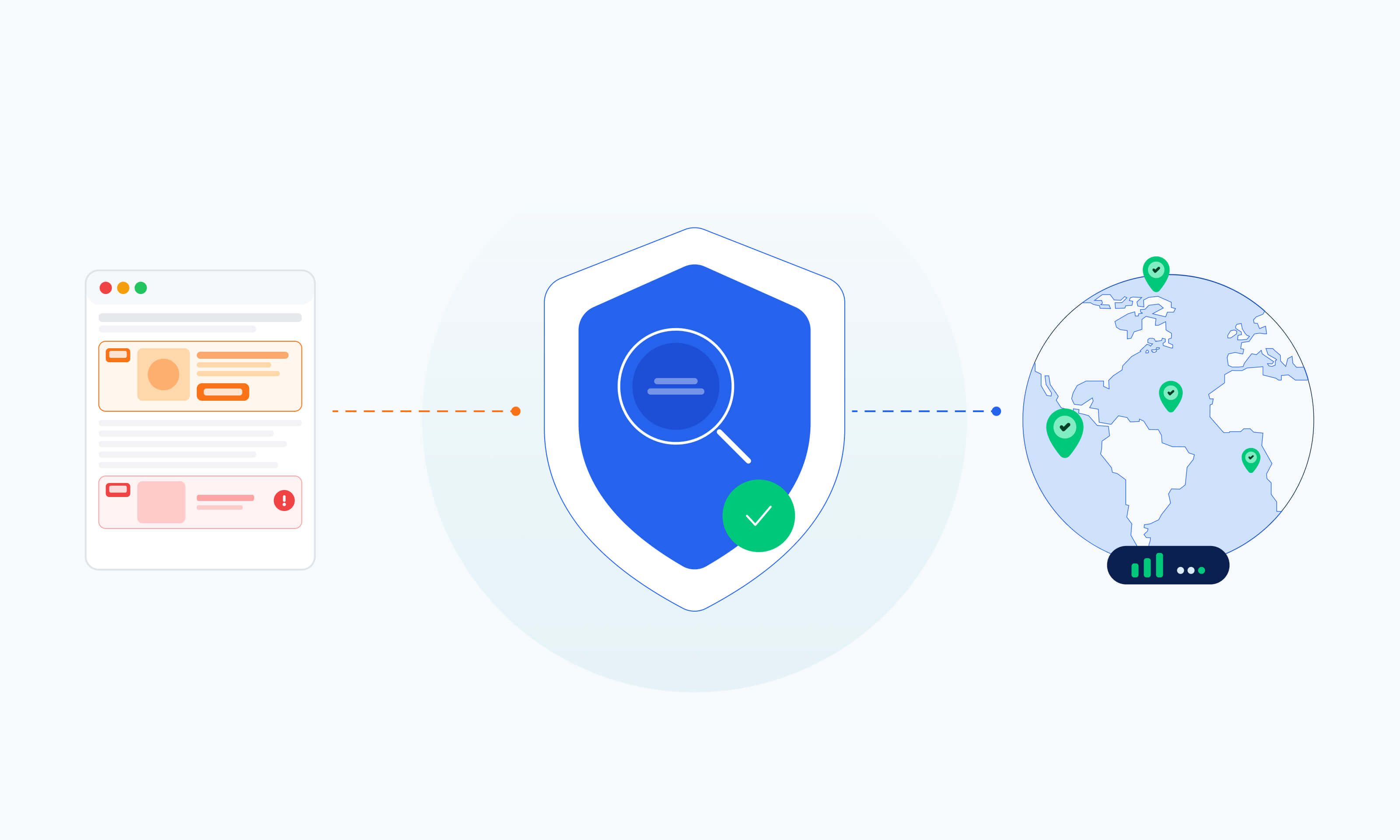
Ad verification now operates under the same hostile conditions as many security operations. Fraud networks use bot traffic, malware, spoofed IPs, and coordinated attack patterns to manipulate ad delivery and hide abuse.
This means verification systems no longer just observe the web. They operate inside adversarial environments where data can be blocked, skewed, or traced back to internal systems.
For ad verification teams, anti-fraud engineers, and technical product managers building verification pipelines, this turns ad verification into an infrastructure problem.
Verification workflows must behave like real users to expose abuse, yet remain completely separate from internal networks and deliver clean signals that you can trust. When the setup leaks fingerprints or exposes internal systems, the collected data becomes less reliable, and the process introduces new risks.
In short: Ad verification tools must act like real users to spot fraud. But when fraudsters can identify these tools, they feed them fake, "clean" data, making the verification useless. This guide explains how to gather accurate ad data without being detected.
The Cybersecurity Risks Hidden in Ad Verification
Most ad verification pipelines were built to collect proof of how ads get served, and they were never designed to protect themselves from sophisticated adversaries. When verification systems can be identified and fed misleading data, ad fraud detection and bot traffic validation become unreliable because networks selectively show clean results while hiding abusive behavior.
Fraud networks adjust their responses when verification traffic shows predictable patterns or behaviors. Requests coming from the same IP ranges, or those with consistent request structures, are often treated differently from organic user traffic.
Some networks return clean-looking results to verification tools while serving manipulated content to real users. Others block or restrict access, creating gaps and blind spots in the collected data.
Verification traffic can also reveal information about internal systems when requests pass through shared infrastructure, potentially exposing how collection and detection tools operate. Subtle signs in request headers, session handling, or timing can be enough to fingerprint verification pipelines.
Without proper isolation, the verification layer itself can become a security risk and a source of biased data.
Infrastructure Limitations That Undermine Verification Accuracy
Verification accuracy can be compromised when ad verification infrastructure isn’t designed for fraud-heavy, adversarial environments. The key limitations include:
- Static or low-quality proxy pools: Proxies that are easy to detect or block reduce coverage and skew data, which makes verification results less reliable and harder to trust.
- IP blocking and browser fingerprinting: These measures interfere with how ads are served to verification systems. They can distort things like bot traffic verification results and hide real user behavior, creating gaps in the data.
- Exposure of internal networks: Routing verification traffic through internal systems can reveal sensitive details about detection tools. This increases the risk of adversaries learning how the verification pipeline operates.
- Manual or semi-automated workflows: Human-dependent processes are prone to mistakes and inconsistencies, which can slow down verification, create gaps in coverage, and reduce the reliability of collected data.
- Uneven geographic coverage: Verification tools that lack presence across multiple regions cannot fully capture how ads are delivered to real users, which makes it difficult to validate regional targeting and detect localized fraud.
- Limited scalability: When verification workloads can’t scale efficiently, processes become harder to repeat. Teams also face challenges when trying to audit results reliably.
- Weak session or traffic isolation: Verification traffic that isn’t properly isolated can expose internal systems to risk. It also reduces the integrity of the collected data, making signals less trustworthy.
When proxy pools are easy to detect or block, ad fraud detection loses coverage and fails to surface how fraud campaigns behave across different environments.
Webshare’s Cybersecurity Integration Features
Webshare is built to fit directly into verification workflows for security teams, providing a proxy infrastructure for cybersecurity that you can control and monitor without touching internal systems. It is designed to give you clear visibility and precision over how verification traffic flows, while keeping the underlying infrastructure safe.
This kind of secure web scraping setup allows teams to gather ad data without leaving traces that fraud networks can exploit.
API-first proxy management
At its core, Webshare manages all proxy operations through APIs, including controlling IP rotation for ad verification, handling sessions, and routing requests. By using APIs, you can automate verification processes and integrate them directly with custom detection pipelines. Automation makes it easier to run repeated tests, scale workloads, and maintain consistency without manual intervention.
Authentication via tokens and IP whitelisting
Access to the proxy network is restricted through secure token-based authentication and configurable IP whitelists. Only authorized systems can send verification requests, which prevents internal networks from being exposed. A setup of this manner makes it safe to run large-scale verification tasks without worrying about revealing sensitive infrastructure.
Compatibility with common cybersecurity tools
Webshare works with existing tools like SIEMs, scraping frameworks, and custom detection systems, meaning that verification data can flow directly into threat intelligence pipelines without additional configuration. You don’t need to build complex adapters or manually move data between systems, which simplifies operations and reduces the chance of errors.
Support for automation, scaling, and regional targeting
Webshare makes it possible to run verification tasks at scale, handling thousands of requests across different networks and systems. While smaller or manual setups can manage only limited workloads, Webshare ensures repeated execution without errors or gaps.
Verification can also be focused on specific regions, giving you insight into how ads appear to users in different locations. Because requests can be scaled, automated, and regionally targeted together, the results are more accurate and reflective of real-world delivery patterns.
How Webshare Improves Ad Verification Capabilities in Practice
Ad fraud verification results are only as good as the infrastructure behind them, especially for workflows like bot traffic validation that depend on realistic traffic signals.
Webshare is built to strengthen each layer of the process. Here’s a rundown of how it improves ad verification in real-world setups:
Clean IP rotation
Rotating proxies prevent verification traffic from looking predictable or concentrated in a small set of IPs, reducing the chance of fraud networks detecting or influencing the measurement. Each request comes from a fresh connection, which gives you a clearer picture of where abuse is occurring and how ad delivery behaves in real-world conditions.
This approach supports effective ad fraud detection by allowing teams to observe fraudulent behavior that would otherwise be hidden from static verification setups.
Geographic diversity
Webshare’s proxy pool spans 195 countries, making it possible to see ads exactly as they appear to local users. This regional insight is critical for validating targeting and spotting discrepancies that might indicate spoofed content or hidden fraud. You can compare results across locations to identify patterns that would be invisible from a single point of access.
Separation of verification traffic from internal networks
Verification traffic never needs to touch core systems, which lowers the risk of exposing internal tools and configurations during routine checks. When verification runs are isolated from production environments, there’s far less surface area for outside parties to observe patterns or infer how detection systems are set up.
That separation makes it harder for fraud networks to study request behavior or reverse-engineer how verification logic works over time. Sensitive detection pipelines remain protected, while still receiving clean, reliable data that can be used for analysis and reporting.
Stable infrastructure
With 99.98 percent uptime, Webshare proxies are available whenever verification checks are needed, so teams can run on demand without worrying about service interruptions. Patterns over time become easier to follow, audit results stay consistent, and comparisons across campaigns hold up better. Stable infrastructure makes ad verification part of day-to-day cybersecurity operations, rather than something fragile that only works once.
Real-World Use Cases for Cybersecurity Teams
Here’s how cybersecurity teams use ad verification in real-world scenarios, based on common problems they deal with in day-to-day security work.
Detecting domain spoofing across regions
Domain spoofing can appear normal in one region while behaving maliciously in another. A security team may see ads resolve correctly in one country but redirect to lookalike domains elsewhere.
Running verification from multiple locations highlights these mismatches. Over time, patterns across regions reveal where spoofing campaigns are being tested before a broader rollout.
Validating mobile vs desktop ad delivery
Ad fraud often treats devices differently, delivering legitimate content to desktops while pushing low-quality or harmful pages to mobile users. This makes spotting inconsistencies difficult without testing both environments.
Running verification that replicates desktop and mobile sessions (by combining proxy rotation with appropriate user agents and device signatures) reveals these differences and highlights how campaigns shift tactics based on device type, timing, or network conditions. Consistently mirroring multiple device sessions provides a clearer, more accurate picture of ad delivery across platforms.
Monitoring competitor ad behavior without attribution
Security teams monitor competitor ad placements to understand how networks operate and where risky inventory appears. Corporate network traffic can alter what ads are served or even trigger blocks, giving an incomplete view.
Using verification traffic that mimics real user activity provides a more accurate look at ads in the wild. Over time, this visibility allows teams to track changes, compare networks, and identify patterns without leaving traces that could affect results.
Feeding clean verification data into threat intelligence models
Ad verification generates large volumes of URLs, redirects, and hosting patterns that feed directly into threat analysis. When the data comes from an isolated and reliable infrastructure, it is far easier to integrate into internal models without interference from blocked or altered responses.
The practice of threat intelligence data collection through verification pipelines allows teams to track recurring domains and infrastructure links over time, adding them to watchlists or enrichment datasets as patterns emerge. This makes it possible to connect ad fraud activity to larger abuse networks and improve proactive threat detection capabilities across the organization.
Conclusion: Building Trustworthy Ad Intelligence Without Increasing Risk
A strong verification setup depends on reliable, well-managed infrastructure, and using proxies from trusted sources is key.
Webshare provides ethically sourced IP addresses, full control over rotation and regional targeting, and isolation from your internal systems to keep your workflows safe. This gives security teams a stable foundation for running verification without exposing internal tools or skewing results.
Webshare is also highly customizable, which makes it easier to match proxy usage to how your verification workflows actually operate. You can start small by testing verification with a limited number of proxies, then fine-tune rotation rules, sessions, and access controls as they validate results. As needs grow, the same setup can scale to support large automated campaigns across regions and device profiles, without changing the underlying workflow design.
With reliable proxy infrastructure in place, teams can improve ad fraud detection over time by running consistent checks across regions, devices, and campaigns without exposing internal systems.
Eliminate Ad Fraud Risks. Explore Webshare's Proxy Solutions.