TL;DR
Learn how to scrape Google Play Store data using Python – from search results to detailed app information and user reviews. We’ll build three practical scrapers:
- Search Scraper: Collects app names, developers, and urls from Google Play search results.
- App Details Scraper: Extracts detailed metadata such as app description, ratings, and developer info.
- Review Scraper: Gathers user reviews with ratings and timestamps.
In this guide, you’ll learn how to programmatically extract this data using Python libraries like Requests and BeautifulSoup, along with Webshare proxies to avoid IP bans.
Prerequisites
Before you start building the Google Play scrapers, make sure your environment is set up properly.
- Python: Version 3.9+ installed on your system
- Libraries: requests and beautifulsoup. You can install the required dependencies using pip:
pip install requests beautifulsoup4pip install pandas lxml- Webshare Proxy: To avoid IP bans or rate limiting from Google, it’s important to route your requests through a proxy. Visit Webshare and create a free account. Once you sign up, select the Free Plan, which provides 10 shared datacenter proxies, 1 GB/month bandwidth and options for static or rotating proxies. After logging in, navigate to the dashboard where you’ll find the proxy host, port, username and password.
Scraping Google Play Search
Let’s build a Python scraper that extracts app listings directly from Google Play search results. The goal is to collect structured data such as app names, links, ratings, and prices – all stored neatly in a CSV file.
Step 1: Define search terms
Begin by defining a list of keywords that represent the types of apps you want to scrape. These could be industry-specific, such as “crypto wallet,” “fitness tracker,” or “photo editor.” For each keyword, the script automatically builds a URL in this format:
https://play.google.com/store/search?q=<your-term>&c=apps&hl=enEach URL represents a results page containing apps that match the search term.
Step 2: Configure session and proxies
Before sending requests, establish a requests session with a custom User-Agent to mimic a real browser. To avoid temporary IP bans from Google, route all requests through Webshare proxies.
Step 3: Fetch and parse search pages
- For each search term, send a request to the Google Play search results page using your configured proxy and headers to avoid detection or rate limits.
- Parse the returned HTML with BeautifulSoup to make it easier to locate app listings.
- Detect app containers using multiple strategies to handle layout variations.
- If no listings appear, fall back to alternative methods such as scanning for app covers or links containing “/store/apps/details”.
Step 4: Extract key app information
- From each app block, extract the title, full app link, and cover image.
- Capture the average rating by identifying numeric or star patterns to ensure accuracy across different layouts.
- Check for a price label. If a price is not available, assume the app is free; otherwise, store the detected price label.
- Store all extracted details in memory for later export to a CSV file.
Step 5: Remove duplicates and save to CSV
After processing all search terms, remove the duplicate entries based on the app url and write the results to a file. Run the script and you’ll find a file in your working directory.
Here’s the complete code:
import requests
from bs4 import BeautifulSoup
import urllib.parse
import csv
import re

def scrape_play_store_apps_enhanced(search_terms):
    """Enhanced version with fixed rating extraction"""

    proxies = {
        "http": "http://username:password@p.webshare.io:80",
        "https": "http://username:password@p.webshare.io:80"
    }

    session = requests.Session()
    session.headers.update({
        'User-Agent': 'Mozilla/5.0 (Windows NT 10.0; Win64; x64) AppleWebKit/537.36 (KHTML, like Gecko) Chrome/120.0.0.0 Safari/537.36'
    })

    all_apps = []

    for term in search_terms:
        query = urllib.parse.quote(term)
        url = f"https://play.google.com/store/search?q={query}&c=apps&hl=en"
        print(f"Scraping: {url}")

        try:
            response = session.get(url, proxies=proxies, timeout=15)
            response.raise_for_status()
            soup = BeautifulSoup(response.content, 'html.parser')

            # Multiple approaches to find app containers
            apps = []

            # Method 1: Common container classes for Google Play apps
            apps.extend(soup.find_all('div', class_='ULeU3b'))
            apps.extend(soup.find_all('div', class_='VfPpkd-WsjYwc'))

            # Method 2: Look for divs containing app cards
            if not apps:
                app_cards = soup.find_all('div', class_=lambda x: x and 'cover' in x.lower())
                apps.extend(app_cards)

            # Method 3: Find by app link pattern
            if not apps:
                app_links = soup.find_all('a', href=lambda x: x and '/store/apps/details?id=' in x)
                for link in app_links:
                    parent_card = link.find_parent('div')
                    if parent_card and parent_card not in apps:
                        apps.append(parent_card)

            for app in apps:
                try:
                    # Extract title with multiple selectors
                    title = 'N/A'
                    title_selectors = [
                        'div.Epkrse', 'div.nnK0zc', 'div.cXFu1',
                        'span.DdYX5', 'div[aria-label]', 'h3'
                    ]

                    for selector in title_selectors:
                        title_elem = app.select_one(selector)
                        if title_elem and title_elem.get_text(strip=True):
                            title = title_elem.get_text(strip=True)
                            break

                    # Extract app URL
                    app_url = 'N/A'
                    link_elem = app.find('a', href=True)
                    if link_elem:
                        href = link_elem['href']
                        if '/store/apps/details?id=' in href:
                            app_url = f"https://play.google.com{href}" if href.startswith('/') else href

                    # Skip if no valid URL found
                    if app_url == 'N/A':
                        continue

                    # Extract cover/logo URL
                    cover_url = 'N/A'
                    logo_url = 'N/A'
                    img_elem = app.find('img', src=True)
                    if img_elem:
                        cover_url = img_elem.get('src') or img_elem.get('data-src') or 'N/A'
                        logo_url = cover_url

                    # EXTRACT RATING - FIXED BASED ON IMAGE
                    reviews_avg = 'N/A'

                    # Method 1: Look for rating in the format "4.4 ★"
                    rating_text = app.get_text()
                    rating_match = re.search(r'(\d+\.\d+)\s*★', rating_text)
                    if rating_match:
                        reviews_avg = rating_match.group(1)
                    else:
                        # Method 2: Look for numeric pattern near star symbols
                        rating_match = re.search(r'(\d+\.\d+)\s*[★⭐]', rating_text)
                        if rating_match:
                            reviews_avg = rating_match.group(1)
                        else:
                            # Method 3: Look for common rating classes
                            rating_selectors = [
                                'div[aria-label*="star"]',
                                'span[aria-label*="star"]',
                                'div.TT9eCd',
                                'div.w2kbF',
                                'div.Yx2Aie',
                                'span.rating'
                            ]
                            for selector in rating_selectors:
                                rating_elem = app.select_one(selector)
                                if rating_elem:
                                    rating_text = rating_elem.get_text(strip=True)
                                    num_match = re.search(r'(\d+\.\d+)', rating_text)
                                    if num_match:
                                        reviews_avg = num_match.group(1)
                                        break

                    # If still not found, try to find any numeric rating in the app card
                    if reviews_avg == 'N/A':
                        all_text = app.get_text()
                        # Look for patterns like "4.4" in the text
                        number_pattern = re.findall(r'\b\d+\.\d+\b', all_text)
                        if number_pattern:
                            # Assume the first number between 1.0 and 5.0 is the rating
                            for num in number_pattern:
                                if 1.0 <= float(num) <= 5.0:
                                    reviews_avg = num
                                    break

                    # Extract price
                    price = 'Free'
                    price_selectors = [
                        'span.VfPpfd',
                        'span.ePXqnb',
                        'span.T4LgNb',
                        'button[aria-label*="$"]',
                        'span[class*="price"]'
                    ]
                    for selector in price_selectors:
                        price_elem = app.select_one(selector)
                        if price_elem:
                            price_text = price_elem.get_text(strip=True)
                            if price_text and price_text.lower() not in ['install', '']:
                                # Clean price text
                                price = re.sub(r'\s+', ' ', price_text).strip()
                                break

                    all_apps.append({
                        'title': title,
                        'app_url': app_url,
                        'cover_url': cover_url,
                        'logo_url': logo_url,
                        'reviews_avg': reviews_avg,
                        'price': price
                    })

                    print(f"✓ Found: {title} | Rating: {reviews_avg} | Price: {price}")

                except Exception as e:
                    print(f"Error parsing app: {e}")
                    continue

            print(f"Found {len([a for a in all_apps if a['title'] != 'N/A'])} apps for '{term}'")

        except Exception as e:
            print(f"Error while processing '{term}': {e}")
            continue

    # Remove duplicates based on app_url
    unique_apps = []
    seen_urls = set()
    for app in all_apps:
        if app['app_url'] not in seen_urls and app['title'] != 'N/A':
            seen_urls.add(app['app_url'])
            unique_apps.append(app)

    # Write data to CSV
    with open('google_play_apps.csv', 'w', newline='', encoding='utf-8') as csv_file:
        writer = csv.DictWriter(csv_file, fieldnames=[
            'title', 'app_url', 'cover_url', 'logo_url', 'reviews_avg', 'price'
        ])
        writer.writeheader()
        writer.writerows(unique_apps)

    print(f"\nCSV file created successfully with {len(unique_apps)} unique app entries.")

    # Show sample of ratings found
    print("\nSample ratings found:")
    for app in unique_apps[:5]:
        print(f"  {app['title']}: {app['reviews_avg']}")

    return unique_apps

# Simple version with just the rating fix
def scrape_play_store_apps_simple(search_terms):
    """Simple version focused on fixing the rating extraction"""

    proxies = {
        "http": "http://username:password@p.webshare.io:80",
        "https": "http://username:password@p.webshare.io:80"
    }

    session = requests.Session()
    session.headers.update({
        'User-Agent': 'Mozilla/5.0 (Windows NT 10.0; Win64; x64) AppleWebKit/537.36'
    })

    all_apps = []

    for term in search_terms:
        query = urllib.parse.quote(term)
        url = f"https://play.google.com/store/search?q={query}&c=apps&hl=en"
        print(f"Scraping: {url}")

        try:
            response = session.get(url, proxies=proxies, timeout=15)
            soup = BeautifulSoup(response.content, 'html.parser')

            # Find all app containers
            apps = soup.find_all('div', class_=['ULeU3b', 'VfPpkd-WsjYwc'])

            for app in apps:
                # Extract title
                title_elem = app.find('div', class_=['Epkrse', 'nnK0zc'])
                title = title_elem.get_text(strip=True) if title_elem else 'N/A'

                # Extract app URL
                link_elem = app.find('a', href=True)
                app_url = f"https://play.google.com{link_elem['href']}" if link_elem else 'N/A'

                # Extract cover image
                img_elem = app.find('img', src=True)
                cover_url = img_elem['src'] if img_elem else 'N/A'
                logo_url = cover_url

                # EXTRACT RATING - SIMPLE FIX
                reviews_avg = 'N/A'
                app_text = app.get_text()

                # Look for pattern like "4.4 ★" from your image
                rating_match = re.search(r'(\d+\.\d+)\s*★', app_text)
                if rating_match:
                    reviews_avg = rating_match.group(1)

                # Extract price
                price_elem = app.find('span', class_=['VfPpfd', 'ePXqnb'])
                price = price_elem.get_text(strip=True) if price_elem else 'Free'

                if title != 'N/A' and app_url != 'N/A':
                    all_apps.append({
                        'title': title,
                        'app_url': app_url,
                        'cover_url': cover_url,
                        'logo_url': logo_url,
                        'reviews_avg': reviews_avg,
                        'price': price
                    })

        except Exception as e:
            print(f"Error with '{term}': {e}")
            continue

    # Save to CSV
    with open('google_play_apps.csv', 'w', newline='', encoding='utf-8') as f:
        writer = csv.DictWriter(f, fieldnames=['title', 'app_url', 'cover_url', 'logo_url', 'reviews_avg', 'price'])
        writer.writeheader()
        writer.writerows(all_apps)

    print(f"Saved {len(all_apps)} apps to google_play_apps.csv")

# Example usage
if __name__ == "__main__":
    search_terms = [
        "bitcoin exchange",
        "ethereum exchange",
        "crypto wallet",
        "binance",
        "coinbase"
    ]

    # Use the enhanced version for best results
    scrape_play_store_apps_enhanced(search_terms)
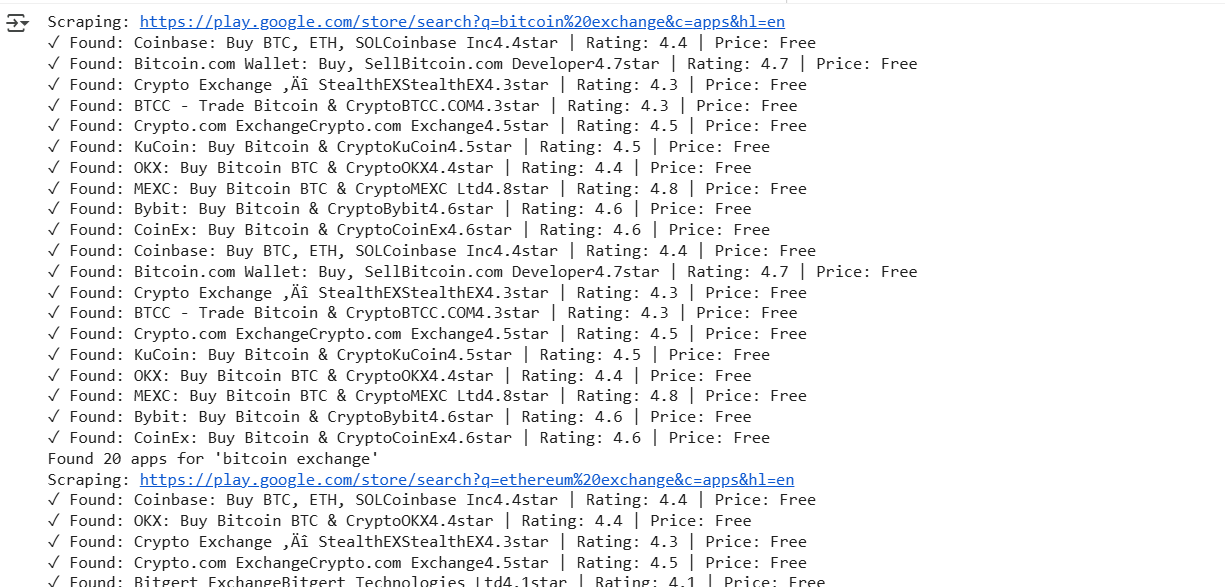
Here’s how the output looks like:
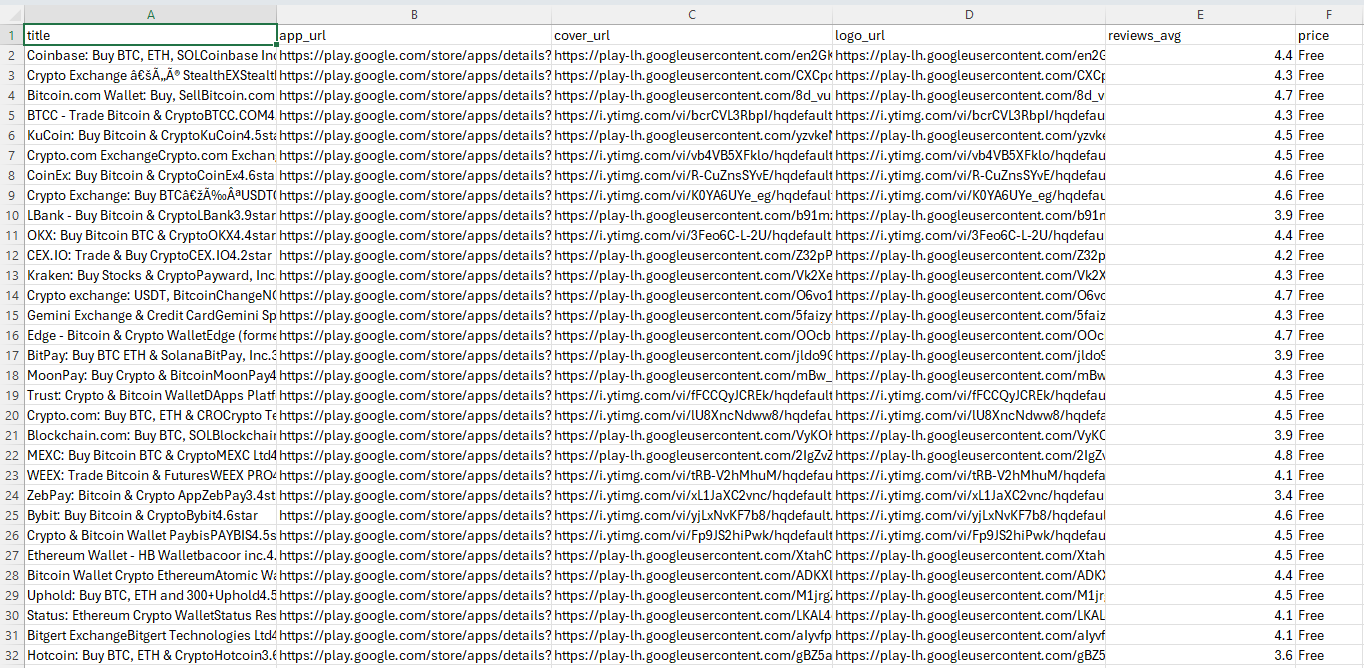
The generated csv is as:
Scraping Google Play Apps
In this section, we’ll enhance the basic search scraper by visiting each app’s individual product page to extract deeper insights – such as the developer name, description, reviews, and ratings.
Step 1: Load the Input File
- Start by reading the CSV file that contains app listings gathered from the previous search scraper.
- Each row includes basic information like the title, app link, cover image, and price.
- Optionally, you can limit how many apps to process for testing purposes.
Step 2: Configure the Proxy and Headers
- Use your Webshare proxy credentials to route traffic safely and avoid IP bans.
- Add a custom user-agent header to make each request look like a normal browser visit.
- These configurations help maintain stable access to Google Play pages while scraping multiple apps.
Step 3: Fetch and Enrich App Details
- For each app URL in the CSV, send a request to its detail page on the Play Store using the configured proxy and headers.
- Wait for a short delay between requests to avoid overwhelming the server and reduce the risk of being rate-limited.
- Parse the returned HTML content with BeautifulSoup to prepare for structured data extraction.
- Extract the developer’s name and profile link from the page, using fallback methods if the primary element is not found.
- Capture the app description from the content section or, if missing, use the meta description as a fallback.
- Retrieve the average rating and the total number of reviews, applying fallback patterns to ensure values are captured even if the layout has changed slightly.
- Collect a small sample of recent user reviews, including each reviewer’s name, review date, rating, and a short excerpt of the review text.
- Store the recent reviews as a JSON array inside the CSV for easy reference or later parsing.
Step 4: Save enriched data to CSV
Once all apps are processed, the enriched dataset is written to a new CSV file containing all extracted fields. Here’s the complete code:
import requests
import csv
import json
import time
from bs4 import BeautifulSoup
from itertools import islice
import re

def enrich_play_store_apps(input_file='google_play_apps.csv', output_file='enriched_google_play_apps.csv', limit=None):
    """Enrich Google Play Store apps with detailed information from their pages"""

    # Proxy setup
    proxies = {
        "http": "http://username:password@p.webshare.io:80",
        "https": "http://username:password@p.webshare.io:80"
    }

    headers = {
        'User-Agent': 'Mozilla/5.0 (Windows NT 10.0; Win64; x64) AppleWebKit/537.36 (KHTML, like Gecko) Chrome/120.0.0.0 Safari/537.36'
    }

    enriched_apps = []

    with open(input_file, 'r', encoding='utf-8') as infile:
        reader = csv.DictReader(infile)
        rows = list(reader)

        if limit:
            rows = rows[:limit]

        for i, row in enumerate(rows):
            url = row.get('app_url', '').strip()
            if not url or url == 'N/A':
                continue

            try:
                print(f"Scraping [{i+1}/{len(rows)}]: {url}")
                resp = requests.get(url, headers=headers, proxies=proxies, timeout=15)
                resp.raise_for_status()
                soup = BeautifulSoup(resp.content, 'html.parser')

                # EXTRACT DEVELOPER NAME
                developer_name = 'N/A'
                dev_elem = soup.find('a', href=re.compile(r'/store/apps/developer\?id='))
                if not dev_elem:
                    dev_elem = soup.find('div', string=re.compile(r'Developer'))
                    if dev_elem:
                        dev_elem = dev_elem.find_next_sibling('div')
                if dev_elem:
                    developer_name = dev_elem.get_text(strip=True)

                # EXTRACT DEVELOPER URL
                developer_url = 'N/A'
                dev_link = soup.find('a', href=re.compile(r'/store/apps/developer\?id='))
                if dev_link and dev_link.get('href'):
                    developer_url = f"https://play.google.com{dev_link['href']}"

                # EXTRACT DESCRIPTION
                description = 'N/A'
                desc_elem = soup.find('div', {'data-g-id': 'description'})
                if not desc_elem:
                    desc_elem = soup.find('div', class_='bARER')
                if not desc_elem:
                    # Try meta description
                    meta_desc = soup.find('meta', {'name': 'description'})
                    if meta_desc:
                        description = meta_desc.get('content', 'N/A')[:500]
                if desc_elem:
                    description = desc_elem.get_text(strip=True)[:500]

                # EXTRACT REVIEWS AVG (from detail page - more accurate)
                reviews_avg = row.get('reviews_avg', 'N/A')
                rating_elem = soup.find('div', class_=['TT9eCd', 'jILTFe'])
                if rating_elem:
                    rating_text = rating_elem.get_text(strip=True)
                    rating_match = re.search(r'(\d+\.\d+)', rating_text)
                    if rating_match:
                        reviews_avg = rating_match.group(1)

                # EXTRACT REVIEWS COUNT
                reviews_count = 'N/A'
                count_elem = soup.find('div', class_='EHUI5b')


                if count_elem:
                    count_text = count_elem.get_text(strip=True)
                    count_match = re.search(r'([\d,]+[KMB]?)', count_text)  # Handle formats like "897K"
                    if count_match:
                        reviews_count = count_match.group(1)

                # Fallback for reviews count
                if reviews_count == 'N/A':
                    # Look for pattern like "X reviews"
                    count_text = soup.get_text()
                    count_match = re.search(r'([\d,]+[KMB]?)\s+reviews', count_text)
                    if count_match:
                        reviews_count = count_match.group(1)

                # EXTRACT RECENT REVIEWS
                recent_reviews = extract_recent_reviews(soup)

                # Create enriched app entry
                enriched_app = {
                    'title': row.get('title', 'N/A'),
                    'app_url': url,
                    'cover_url': row.get('cover_url', 'N/A'),
                    'logo_url': row.get('logo_url', 'N/A'),
                    'price': row.get('price', 'Free'),
                    'developer_name': developer_name,
                    'developer_url': developer_url,
                    'description': description,
                    'reviews_avg': reviews_avg,
                    'reviews_count': reviews_count,
                    'recent_reviews': json.dumps(recent_reviews, ensure_ascii=False) if recent_reviews else '[]'
                }

                enriched_apps.append(enriched_app)

                print(f" Enriched: {row.get('title', 'N/A')}")
                print(f" Developer: {developer_name} | Rating: {reviews_avg} | Reviews: {reviews_count}")

            except Exception as e:
                print(f"Error scraping {url}: {e}")
                # Still add the app with basic data
                enriched_apps.append({
                    'title': row.get('title', 'N/A'),
                    'app_url': url,
                    'cover_url': row.get('cover_url', 'N/A'),
                    'logo_url': row.get('logo_url', 'N/A'),
                    'price': row.get('price', 'Free'),
                    'developer_name': 'N/A',
                    'developer_url': 'N/A',
                    'description': 'N/A',
                    'reviews_avg': row.get('reviews_avg', 'N/A'),
                    'reviews_count': 'N/A',
                    'recent_reviews': '[]'
                })

            # delay between requests
            time.sleep(2)

    # Write enriched data to CSV
    with open(output_file, 'w', newline='', encoding='utf-8') as outfile:
        fieldnames = [
            'title', 'app_url', 'cover_url', 'logo_url', 'price',
            'developer_name', 'developer_url', 'description',
            'reviews_avg', 'reviews_count', 'recent_reviews'
        ]
        writer = csv.DictWriter(outfile, fieldnames=fieldnames)
        writer.writeheader()
        writer.writerows(enriched_apps)

    print(f"\nEnrichment complete! {len(enriched_apps)} apps saved to {output_file}")

    # Show summary
    successful = len([app for app in enriched_apps if app['developer_name'] != 'N/A'])
    print(f"Successfully enriched: {successful}/{len(enriched_apps)} apps")

    return enriched_apps

def extract_recent_reviews(soup):
    """Extract recent reviews from the app page with fixed rating extraction"""
    reviews = []

    # Multiple selectors for review containers
    review_selectors = ['div.RHo1pe', 'div[data-g-id]', 'div.SingleReview']

    for selector in review_selectors:
        review_containers = soup.select(selector)
        for container in review_containers[:5]:  # Get 5 most recent
            try:
                author = container.select_one('.X5PpBb')
                date = container.select_one('.bp9Aid')
                text = container.select_one('.h3YV2d')

                # FIXED: Extract rating from aria-label attribute
                review_rating = 'N/A'
                rating_elem = container.select_one('.iXRFPc')
                if rating_elem:
                    aria_label = rating_elem.get('aria-label', '')
                    rating_match = re.search(r'Rated\s+(\d+)\s+stars', aria_label)
                    if rating_match:
                        review_rating = rating_match.group(1)

                # Alternative method: count the filled stars
                if review_rating == 'N/A' and rating_elem:
                    filled_stars = rating_elem.select('.Z1Dz7b')  # Filled stars
                    if filled_stars:
                        review_rating = str(len(filled_stars))

                # Only add if we have meaningful content
                if text and text.get_text(strip=True) and len(text.get_text(strip=True)) > 10:
                    reviews.append({
                        'author': author.get_text(strip=True) if author else 'Anonymous',
                        'date': date.get_text(strip=True) if date else 'N/A',
                        'rating': review_rating,
                        'text': text.get_text(strip=True)[:300]
                    })

            except Exception as e:
                print(f"Error parsing review: {e}")
                continue

    return reviews

# Alternative function with better element detection
def enrich_play_store_apps_detailed(input_file='google_play_apps.csv', output_file='enriched_google_play_apps.csv', limit=10):
    """More detailed enrichment with better element detection"""

    proxies = {
        "http": "http://username:password@p.webshare.io:80",
        "https": "http://username:password@p.webshare.io:80"
    }

    headers = {
        'User-Agent': 'Mozilla/5.0 (Windows NT 10.0; Win64; x64) AppleWebKit/537.36'
    }

    enriched_apps = []

    with open(input_file, 'r', encoding='utf-8') as infile:
        reader = csv.DictReader(infile)
        rows = list(reader)

        if limit:
            rows = rows[:limit]

        for i, row in enumerate(rows):
            url = row.get('app_url', '').strip()
            if not url or url == 'N/A':
                continue

            try:
                print(f"Scraping [{i+1}/{len(rows)}]: {row.get('title', 'Unknown')}")
                resp = requests.get(url, headers=headers, proxies=proxies, timeout=15)
                soup = BeautifulSoup(resp.content, 'html.parser')

                # Extract all data using multiple methods
                app_data = extract_app_data(soup, row)
                enriched_apps.append(app_data)

                print(f"{app_data['title']} | Dev: {app_data['developer_name']} | Reviews: {app_data['reviews_count']}")

            except Exception as e:
                print(f"Error: {e}")
                enriched_apps.append(create_fallback_app(row))

            time.sleep(1)

    # Save to CSV
    with open(output_file, 'w', newline='', encoding='utf-8') as outfile:
        fieldnames = [
            'title', 'app_url', 'cover_url', 'logo_url', 'price',
            'developer_name', 'developer_url', 'description',
            'reviews_avg', 'reviews_count', 'recent_reviews'
        ]
        writer = csv.DictWriter(outfile, fieldnames=fieldnames)
        writer.writeheader()
        writer.writerows(enriched_apps)

    print(f"\nSaved {len(enriched_apps)} enriched apps to {output_file}")
    return enriched_apps

def extract_app_data(soup, original_row):
    """Extract all app data from the detail page"""

    # Developer info
    developer_name = 'N/A'
    developer_url = 'N/A'

    dev_link = soup.find('a', href=re.compile(r'/store/apps/developer\?id='))
    if dev_link:
        developer_name = dev_link.get_text(strip=True)
        developer_url = f"https://play.google.com{dev_link['href']}"

    # Description
    description = 'N/A'
    desc_selectors = ['div[data-g-id="description"]', 'div.bARER', 'div.ClM7O']
    for selector in desc_selectors:
        desc_elem = soup.select_one(selector)
        if desc_elem:
            description = desc_elem.get_text(strip=True)[:500]
            break

    # Reviews average
    reviews_avg = original_row.get('reviews_avg', 'N/A')
    rating_elem = soup.select_one('div.TT9eCd, div.jILTFe')
    if rating_elem:
        rating_match = re.search(r'(\d+\.\d+)', rating_elem.get_text())
        if rating_match:
            reviews_avg = rating_match.group(1)

    # Reviews count
    reviews_count = 'N/A'
    count_elem = soup.select_one('div.EHUI5b')
    if count_elem:
        count_match = re.search(r'([\d,]+[KMB]?)', count_elem.get_text())
        if count_match:
            reviews_count = count_match.group(1)

    # Recent reviews
    recent_reviews = extract_recent_reviews(soup)

    return {
        'title': original_row.get('title', 'N/A'),
        'app_url': original_row.get('app_url', 'N/A'),
        'cover_url': original_row.get('cover_url', 'N/A'),
        'logo_url': original_row.get('logo_url', 'N/A'),
        'price': original_row.get('price', 'Free'),
        'developer_name': developer_name,
        'developer_url': developer_url,
        'description': description,
        'reviews_avg': reviews_avg,
        'reviews_count': reviews_count,
        'recent_reviews': json.dumps(recent_reviews, ensure_ascii=False) if recent_reviews else '[]'
    }

def create_fallback_app(row):
    """Create app entry with fallback data when scraping fails"""
    return {
        'title': row.get('title', 'N/A'),
        'app_url': row.get('app_url', 'N/A'),
        'cover_url': row.get('cover_url', 'N/A'),
        'logo_url': row.get('logo_url', 'N/A'),
        'price': row.get('price', 'Free'),
        'developer_name': 'N/A',
        'developer_url': 'N/A',
        'description': 'N/A',
        'reviews_avg': row.get('reviews_avg', 'N/A'),
        'reviews_count': 'N/A',
        'recent_reviews': '[]'
    }

# Example usage
if __name__ == "__main__":
    # Enrich apps from the CSV file
    enrich_play_store_apps(
        input_file='google_play_apps.csv',
        output_file='enriched_google_play_apps.csv',
        limit=20  # Used it for testing. You can remove this line to process all apps
    )
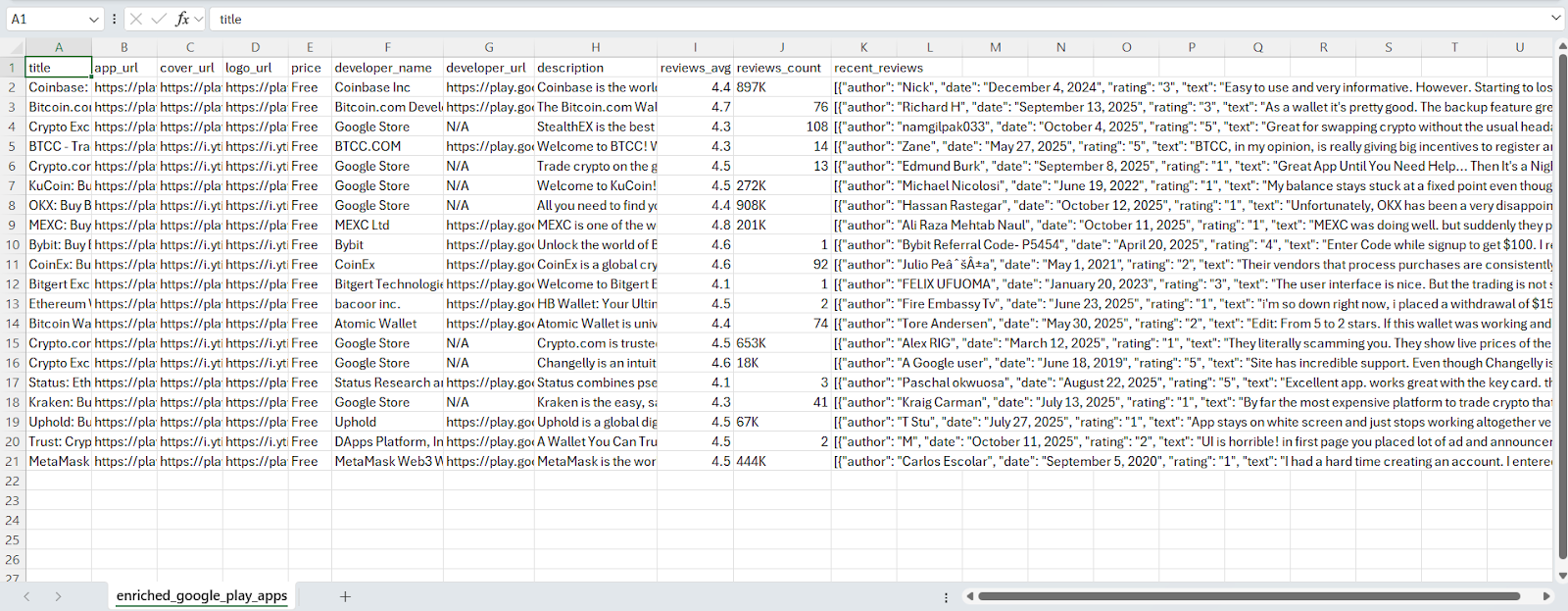
Here’s how the output looks like:
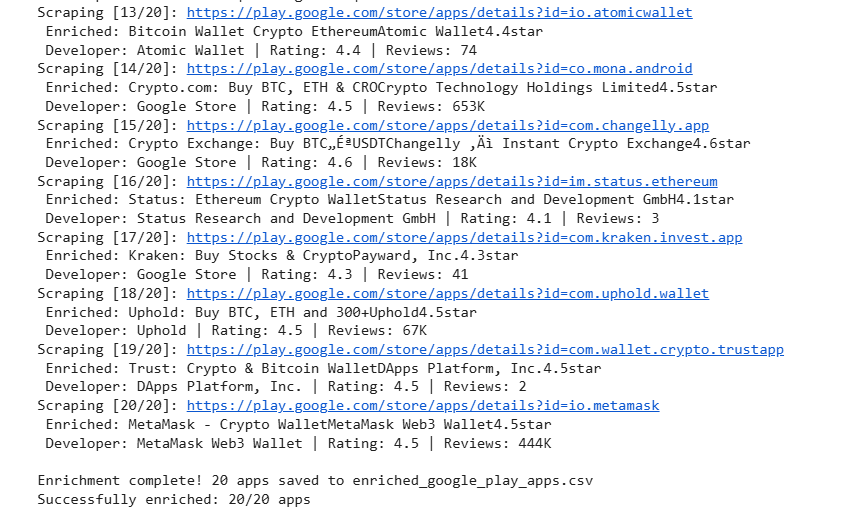
The generated csv is as:
Scraping Google Play Apps With All Reviews
Step 1: Prepare and read your CSV file
- Place your google_play_apps.csv file in the same folder as the script.
- Make sure it uses commas as separators and double quotes around values.
- Each row should have six fields – title, app URL, cover URL, logo URL, average rating, and price.
- If your CSV has extra columns or different formatting, adjust the reading logic or use csv.DictReader so every app’s link is read correctly.
Step 2: Ensure valid app urls
- Check that each app link in your CSV includes the id= part.
- If any URL doesn’t include that, edit it manually or normalize it before running the script.
- Without the id=, the scraper won’t know which app to target.
Step 3: Run the main review scraper
- Call the main method to start scraping all reviews for every app in your CSV.
- The scraper will automatically try different techniques to collect reviews.
- Let it complete one app before it moves to the next – it saves progress as it goes.
Step 4: Try to fetch all reviews from the main page
- The scraper will make multiple requests using parameters like showAllReviews=true.
- Don’t worry if you still see only a few reviews – Google Play often hides more behind JavaScript.
- Just let this step finish before moving on.
Step 5: Extract hidden data from scripts
- When the main page loads, check if there are hidden <script> blocks that contain review text.
- The scraper will automatically read them, but if you’re customizing, make sure those scripts are included.
- This helps you capture more review content that might not appear visibly on the page.
Step 6: Collect reviews from different languages and countries
- Google Play often shows different sets of reviews depending on the language or country of the user. To uncover these, run the scraper with multiple hl (language) and gl (country) values.
- Reviews gathered from these alternate versions are then merged with the main dataset to provide more complete coverage.
Step 7: Attempt dynamic review fetching
- Enable the AJAX-style header requests (already built in).
- This step tries to get reviews loaded dynamically in browsers.
- Just ensure your proxies are active – otherwise, requests may fail.
Step 8: Parse everything thoroughly
- Let the parser go through all review sections in the page HTML.
- It automatically checks known review containers, keywords, and structured data.
- You don’t need to adjust this unless you want to fine-tune extraction rules.
Step 9: Save your results
- After every app, the script saves progress in progress_backup.json so nothing is lost.
- When all apps are processed, the final data is saved to enriched_apps_with_all_reviews.json.
- If the script stops midway, you can restart it – it will pick up from the backup file.
Step 10: Use delays and proxies
- Don’t remove the random delays between apps – they prevent Google from blocking your requests.
- Keep your proxy list updated and rotate them if you notice failed requests.
- If a request fails, the script will skip that app and continue automatically – no need to restart manually.
Here’s the complete code:
import pandas as pd
import requests
from bs4 import BeautifulSoup
import json
import time
import random
import os
import re
import csv
class AdvancedGooglePlayReviewScraper:
def __init__(self):
self.proxies = {
"http": "http://username:password@p.webshare.io:80",
"https": "http://username:password@p.webshare.io:80"
}
self.session = requests.Session()
self.session.proxies.update(self.proxies)
# Comprehensive headers to mimic real browser
self.session.headers.update({
'User-Agent': 'Mozilla/5.0 (Windows NT 10.0; Win64; x64) AppleWebKit/537.36 (KHTML, like Gecko) Chrome/120.0.0.0 Safari/537.36',
'Accept': 'text/html,application/xhtml+xml,application/xml;q=0.9,image/webp,image/apng,*/*;q=0.8,application/signed-exchange;v=b3;q=0.7',
'Accept-Language': 'en-US,en;q=0.9',
'Accept-Encoding': 'gzip, deflate, br',
'Connection': 'keep-alive',
'Upgrade-Insecure-Requests': '1',
'Sec-Fetch-Dest': 'document',
'Sec-Fetch-Mode': 'navigate',
'Sec-Fetch-Site': 'none',
'Cache-Control': 'max-age=0',
'sec-ch-ua': '"Not_A Brand";v="8", "Chromium";v="120", "Google Chrome";v="120"',
'sec-ch-ua-mobile': '?0',
'sec-ch-ua-platform': '"Windows"',
})
def parse_csv_correctly(self, csv_file_path):
"""Parse the CSV file correctly"""
apps = []
with open(csv_file_path, 'r', encoding='utf-8') as f:
reader = csv.reader(f, delimiter=',', quotechar='"')
# Skip header
next(reader, None)
for row in reader:
if len(row) >= 6:
app_data = {
'title': row[0].strip('"'),
'app_url': row[1].strip('"'),
'cover_url': row[2].strip('"'),
'logo_url': row[3].strip('"'),
'reviews_avg': row[4].strip('"'),
'price': row[5].strip('"')
}
apps.append(app_data)
return apps
def get_app_id_from_url(self, url):
"""Extract app ID from Google Play URL"""
try:
if 'id=' in url:
match = re.search(r'[?&]id=([^&]+)', url)
if match:
return match.group(1)
return None
except:
return None
def scrape_all_reviews_advanced(self, app_url, max_reviews=100):
"""Advanced method to scrape ALL reviews using multiple techniques"""
try:
app_id = self.get_app_id_from_url(app_url)
if not app_id:
print("Could not extract app ID")
return []
print(f"Advanced scraping for: {app_id}")
all_reviews = []
# Strategy 1: Try the "showAllReviews" parameter with different approaches
strategies = [
self.try_show_all_reviews,
self.try_reviews_api_endpoint,
self.try_different_languages,
self.try_country_variations,
self.try_review_feed
]
for strategy in strategies:
if len(all_reviews) >= max_reviews:
break
try:
reviews = strategy(app_id, max_reviews - len(all_reviews))
if reviews:
# Deduplicate reviews
for review in reviews:
if len(all_reviews) >= max_reviews:
break
review_key = f"{review['review_author']}_{review['review_date']}_{review['review_text'][:50]}"
if not any(r.get('_key') == review_key for r in all_reviews):
review['_key'] = review_key
all_reviews.append(review)
print(f"Strategy {strategy.__name__}: {len(reviews)} new reviews, total: {len(all_reviews)}")
time.sleep(2)
except Exception as e:
print(f"Strategy {strategy.__name__} failed: {e}")
continue
# Remove temporary keys
for review in all_reviews:
review.pop('_key', None)
print(f"✓ Total reviews scraped: {len(all_reviews)}")
return all_reviews
except Exception as e:
print(f"Error in advanced scraping: {e}")
return []
def try_show_all_reviews(self, app_id, max_reviews):
"""Try the showAllReviews parameter with various combinations"""
reviews = []
# Different parameter combinations
param_combinations = [
{'hl': 'en', 'gl': 'US', 'showAllReviews': 'true'},
{'hl': 'en', 'gl': 'US', 'showAllReviews': 'true', 'sort': 1},
{'hl': 'en', 'gl': 'US', 'showAllReviews': 'true', 'sort': 2},
{'hl': 'en', 'gl': 'US', 'showAllReviews': 'true', 'sort': 3},
{'hl': 'en', 'gl': 'US', 'showAllReviews': 'true', 'sort': 4},
]
for params in param_combinations:
if len(reviews) >= max_reviews:
break
try:
url = f"https://play.google.com/store/apps/details?id={app_id}"
response = self.session.get(url, params=params, timeout=30)
if response.status_code == 200:
batch_reviews = self.extract_reviews_aggressive(response.text)
for review in batch_reviews:
if len(reviews) >= max_reviews:
break
reviews.append(review)
print(f"Params {params}: {len(batch_reviews)} reviews")
time.sleep(1)
except Exception as e:
continue
return reviews[:max_reviews]
def try_reviews_api_endpoint(self, app_id, max_reviews):
"""Try to find and use the actual reviews API endpoint"""
reviews = []
try:
# First, get the main page to look for API clues
url = f"https://play.google.com/store/apps/details?id={app_id}&hl=en"
response = self.session.get(url, timeout=30)
if response.status_code == 200:
# Look for review data in the page source
soup = BeautifulSoup(response.text, 'html.parser')
# Look for script tags with review data
scripts = soup.find_all('script')
for script in scripts:
if script.string and 'review' in script.string.lower():
# Try to extract review data from script content
script_reviews = self.extract_reviews_from_script(script.string)
for review in script_reviews:
if len(reviews) >= max_reviews:
break
reviews.append(review)
print(f"Script extraction: {len(reviews)} reviews")
except Exception as e:
print(f"API endpoint method failed: {e}")
return reviews[:max_reviews]
def try_different_languages(self, app_id, max_reviews):
"""Try accessing the page in different languages"""
reviews = []
languages = ['en', 'es', 'fr', 'de', 'pt', 'ru', 'ja', 'ko', 'zh']
for lang in languages:
if len(reviews) >= max_reviews:
break
try:
url = f"https://play.google.com/store/apps/details?id={app_id}&hl={lang}&gl=US&showAllReviews=true"
response = self.session.get(url, timeout=30)
if response.status_code == 200:
batch_reviews = self.extract_reviews_aggressive(response.text)
for review in batch_reviews:
if len(reviews) >= max_reviews:
break
reviews.append(review)
print(f"Language {lang}: {len(batch_reviews)} reviews")
time.sleep(1)
except Exception as e:
continue
return reviews[:max_reviews]
def try_country_variations(self, app_id, max_reviews):
"""Try different country codes"""
reviews = []
countries = ['US', 'GB', 'CA', 'AU', 'IN', 'DE', 'FR', 'JP', 'KR', 'BR']
for country in countries:
if len(reviews) >= max_reviews:
break
try:
url = f"https://play.google.com/store/apps/details?id={app_id}&hl=en&gl={country}&showAllReviews=true"
response = self.session.get(url, timeout=30)
if response.status_code == 200:
batch_reviews = self.extract_reviews_aggressive(response.text)
for review in batch_reviews:
if len(reviews) >= max_reviews:
break
reviews.append(review)
print(f"Country {country}: {len(batch_reviews)} reviews")
time.sleep(1)
except Exception as e:
continue
return reviews[:max_reviews]
def try_review_feed(self, app_id, max_reviews):
"""Try to access the review feed directly"""
reviews = []
try:
# This is a more direct approach to get review data
url = f"https://play.google.com/store/apps/details?id={app_id}"
# Add headers that might trigger more data
headers = {
'X-Requested-With': 'XMLHttpRequest',
'Referer': f'https://play.google.com/store/apps/details?id={app_id}',
}
response = self.session.get(url, headers=headers, timeout=30)
if response.status_code == 200:
batch_reviews = self.extract_reviews_aggressive(response.text)
reviews.extend(batch_reviews)
print(f"Review feed: {len(batch_reviews)} reviews")
except Exception as e:
print(f"Review feed method failed: {e}")
return reviews[:max_reviews]
def extract_reviews_aggressive(self, html_content):
"""Aggressively extract reviews from HTML using multiple methods"""
reviews = []
soup = BeautifulSoup(html_content, 'html.parser')
# Method 1: Standard review containers
standard_containers = soup.find_all('div', class_=['RHo1pe', 'EGFGHd'])
for container in standard_containers:
review = self.parse_review_container(container)
if review:
reviews.append(review)
# Method 2: Look for any div that might contain review-like content
all_divs = soup.find_all('div')
for div in all_divs:
text = div.get_text(strip=True)
# Heuristic: if it has substantial text and mentions stars/reviews
if len(text) > 100 and any(keyword in text.lower() for keyword in ['star', 'review', 'rating']):
review = self.parse_review_from_text(text)
if review:
reviews.append(review)
# Method 3: Look for JSON-LD structured data
script_tags = soup.find_all('script', type='application/ld+json')
for script in script_tags:
try:
data = json.loads(script.string)
script_reviews = self.extract_reviews_from_structured_data(data)
reviews.extend(script_reviews)
except:
pass
return reviews
def parse_review_container(self, container):
"""Parse a single review container"""
try:
# AUTHOR
author_elem = container.select_one('.X5PpBb')
author = author_elem.get_text(strip=True) if author_elem else 'Anonymous'
# DATE
date_elem = container.select_one('.bp9Aid')
date = date_elem.get_text(strip=True) if date_elem else 'N/A'
# REVIEW TEXT
text_elem = container.select_one('.h3YV2d')
review_text = text_elem.get_text(strip=True) if text_elem else ''
if not review_text or len(review_text) < 10:
return None
# RATING
rating = self.extract_rating_from_container(container)
# HELPFUL COUNT
helpful_count = self.extract_helpful_count(container)
return {
"review_rating": rating,
"review_date": date,
"review_author": author,
"review_helpful": helpful_count,
"review_text": review_text
}
except Exception as e:
return None
def extract_rating_from_container(self, container):
"""Extract rating from review container"""
try:
rating_elem = container.select_one('.iXRFPc')
if rating_elem:
aria_label = rating_elem.get('aria-label', '')
rating_match = re.search(r'Rated\s+(\d+)\s+stars', aria_label)
if rating_match:
return int(rating_match.group(1))
if rating_elem:
filled_stars = rating_elem.select('.Z1Dz7b')
if filled_stars:
return len(filled_stars)
return 0
except:
return 0
def extract_helpful_count(self, container):
"""Extract helpful count from review container"""
try:
container_text = container.get_text()
helpful_match = re.search(r'(\d+)\s*people found this helpful', container_text)
if helpful_match:
return int(helpful_match.group(1))
return 0
except:
return 0
def extract_reviews_from_script(self, script_content):
"""Extract reviews from script content"""
reviews = []
# Look for review patterns in script content
review_patterns = [
r'"reviewText"\s*:\s*"([^"]+)"',
r'"text"\s*:\s*"([^"]+)"',
r'"description"\s*:\s*"([^"]+)"',
]
for pattern in review_patterns:
matches = re.findall(pattern, script_content)
for match in matches:
if len(match) > 20: # Substantial review text
reviews.append({
"review_rating": 0,
"review_date": "N/A",
"review_author": "Anonymous",
"review_helpful": 0,
"review_text": match
})
return reviews
def extract_reviews_from_structured_data(self, data):
"""Extract reviews from structured data"""
reviews = []
def extract_from_obj(obj):
if isinstance(obj, dict):
if 'reviewBody' in obj and isinstance(obj['reviewBody'], str):
rating = obj.get('reviewRating', {}).get('ratingValue', 0)
author = obj.get('author', {}).get('name', 'Anonymous')
date = obj.get('datePublished', 'N/A')
reviews.append({
"review_rating": int(rating) if rating else 0,
"review_date": date,
"review_author": author,
"review_helpful": 0,
"review_text": obj['reviewBody']
})
# Recursively search nested objects
for value in obj.values():
extract_from_obj(value)
elif isinstance(obj, list):
for item in obj:
extract_from_obj(item)
extract_from_obj(data)
return reviews
def parse_review_from_text(self, text):
"""Parse review from raw text using heuristics"""
try:
# Simple heuristic: if it looks like a review, create a basic review object
if len(text) > 50 and any(keyword in text.lower() for keyword in ['good', 'bad', 'great', 'poor', 'excellent', 'terrible']):
return {
"review_rating": 0,
"review_date": "N/A",
"review_author": "Anonymous",
"review_helpful": 0,
"review_text": text[:500] # Limit length
}
except:
pass
return None
def scrape_all_apps_reviews(self, csv_file_path, output_file='enriched_apps_with_all_reviews.json'):
"""Main function to scrape ALL reviews for all apps"""
try:
apps = self.parse_csv_correctly(csv_file_path)
print(f"Loaded {len(apps)} apps from {csv_file_path}")
enriched_data = []
for i, app_data in enumerate(apps):
try:
title = app_data['title']
app_url = app_data['app_url']
print(f"\n{'='*60}")
print(f"Processing app {i + 1}/{len(apps)}")
print(f"Title: {title[:50]}...")
app_id = self.get_app_id_from_url(app_url)
if not app_id:
print("Invalid URL, skipping...")
continue
app_entry = {
"title": title,
"app_url": app_url,
"cover_url": app_data['cover_url'],
"logo_url": app_data['logo_url'],
"reviews_avg": app_data['reviews_avg'],
"price": app_data['price'],
"reviews": []
}
# Use the advanced method to get ALL reviews
reviews = self.scrape_all_reviews_advanced(app_url, max_reviews=100)
app_entry["reviews"] = reviews
app_entry["total_reviews_scraped"] = len(reviews)
enriched_data.append(app_entry)
# Save progress
with open('progress_backup.json', 'w', encoding='utf-8') as f:
json.dump(enriched_data, f, indent=2, ensure_ascii=False)
print(f"✓ Completed: {len(reviews)} reviews")
delay = random.uniform(3, 6)
time.sleep(delay)
except Exception as e:
print(f"Error processing app: {e}")
continue
# Save final data
with open(output_file, 'w', encoding='utf-8') as f:
json.dump(enriched_data, f, indent=2, ensure_ascii=False)
# Print summary
total_reviews = sum(app.get('total_reviews_scraped', 0) for app in enriched_data)
successful_apps = len([app for app in enriched_data if app.get('total_reviews_scraped', 0) > 0])
print(f"Apps processed: {len(enriched_data)}")
print(f"Apps with reviews: {successful_apps}")
print(f"Total reviews scraped: {total_reviews}")
return enriched_data
except Exception as e:
print(f"Error: {e}")
return []
def main():
scraper = AdvancedGooglePlayReviewScraper()
csv_file = "google_play_apps.csv"
if not os.path.exists(csv_file):
print(f"Error: CSV file '{csv_file}' not found!")
return
enriched_data = scraper.scrape_all_apps_reviews(csv_file)
if __name__ == "__main__":
main()The output looks like this:
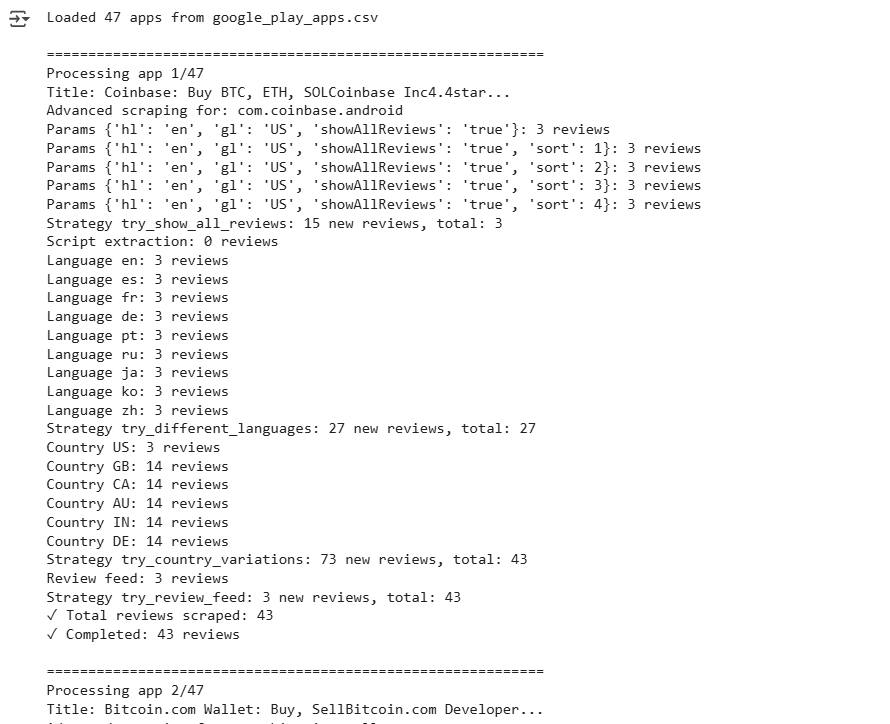
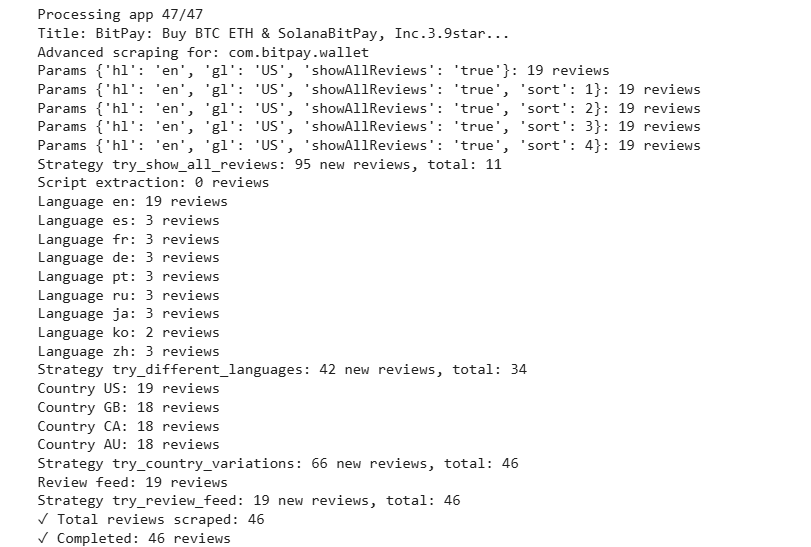

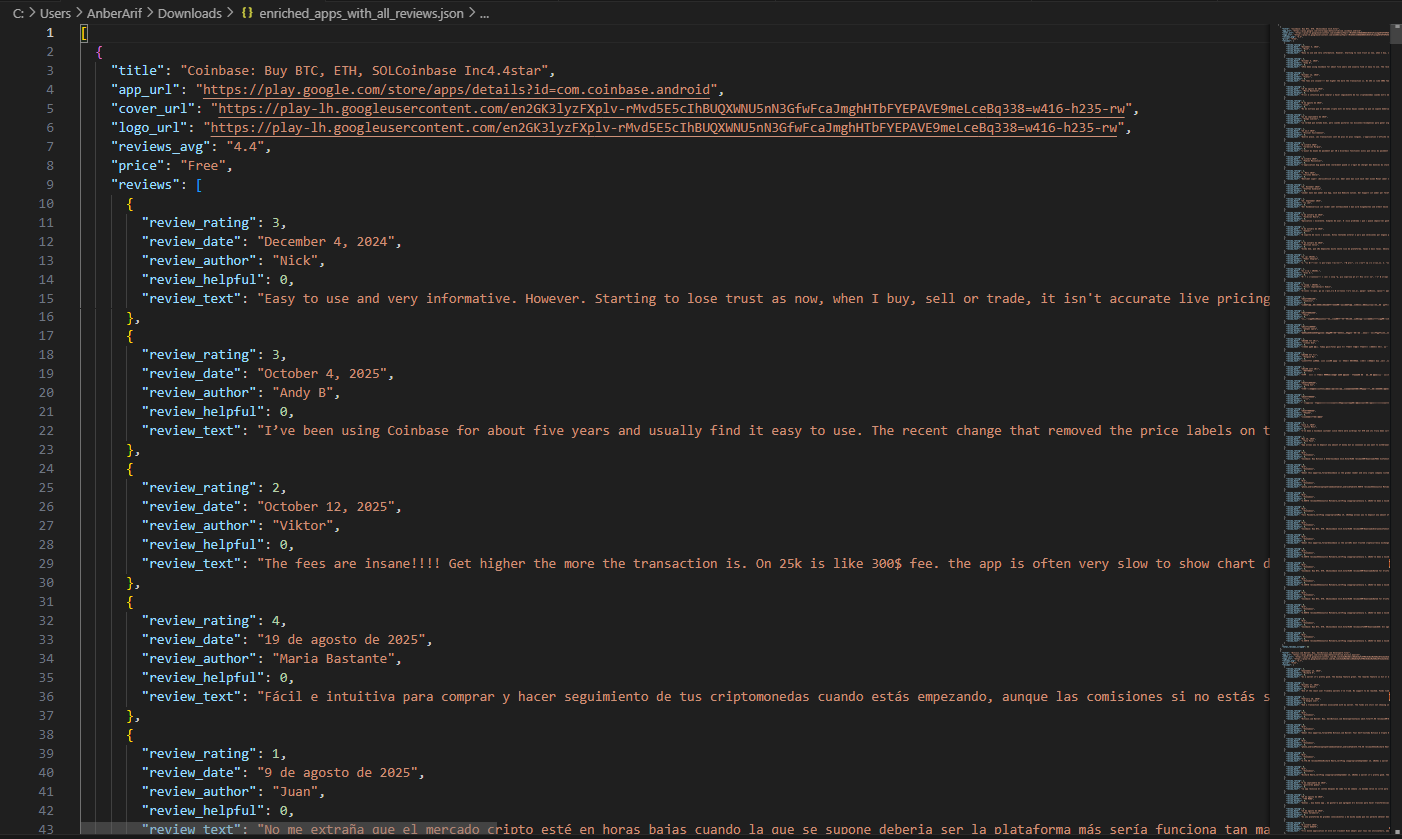
The generated json is as:
Wrapping up: Scrape Google Play – 3 Methods
In this guide, we covered three methods: the first collects app search results, the second extracts detailed app info (name, developer, description, ratings) and initial reviews, and the third gathers all user reviews for full coverage. Use Webshare proxies, rotating headers, and other anti-detection methods plus polite delays to keep scraping reliable and minimize blocks.